
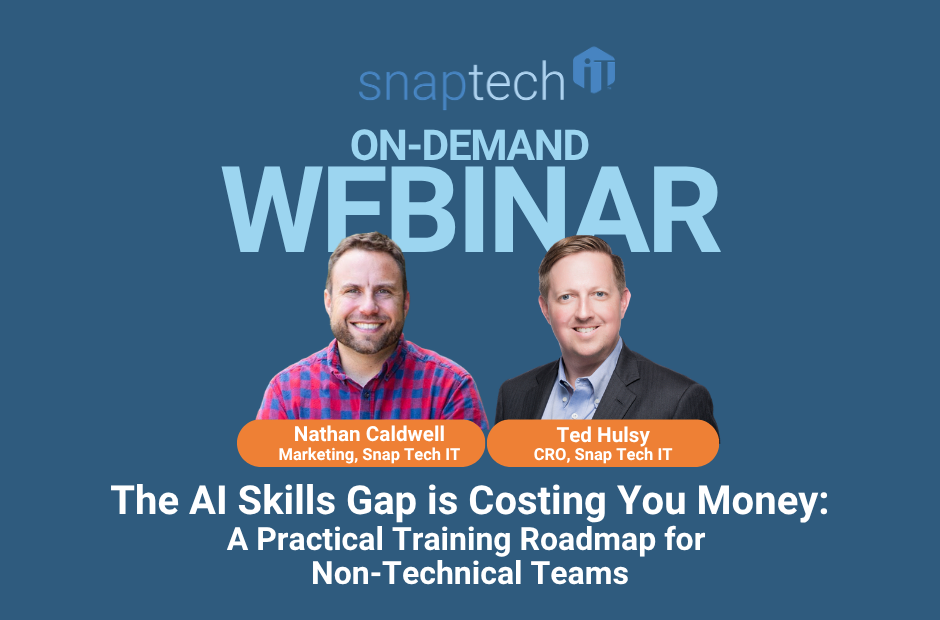
The AI Skills Gap Is Costing You Money: A Practical Training Roadmap for Non-Technical Teams
Buying AI licenses is easy. Turning those licenses into productivity, effective workflows, and measurable business results is much harder.
Too many organizations are giving employees access to AI and essentially telling them to “go figure it out.” Only one in four employees has heard a clear AI plan from their organization, 54% report lacking clear guidelines for AI tool usage, and 68% receive no AI training from their employer.
That skills gap has a cost. Businesses pay for tools employees underuse, while teams continue spending time on work AI could help streamline.
Closing the gap requires a practical training strategy built for the people actually doing the work.
Start With a Secure AI Foundation
Before employees learn what AI can do, they need to understand what they are allowed to do with it.
Businesses should standardize on business-grade AI platforms that provide appropriate security, privacy, and data controls. Employees also need clear policies covering approved tools, acceptable use, company information, and activities that are off-limits.
The goal is not to discourage experimentation. Clear guardrails allow employees to move faster because they know where they can safely innovate.
Connecting AI securely to business information can make it even more valuable. Email, files, meeting information, collaboration platforms, and other company data can provide AI with the context needed to assist with real work—provided those connections are properly governed.
Build Training Around Roles and Real Work
Generic AI demonstrations can generate excitement, but excitement is not the same as capability.
Marketing, sales, finance, operations, HR, and leadership teams have different workflows. Their training should reflect those differences.
Create role-based learning paths and connect each lesson to something employees already do. Instead of simply teaching someone how to write a better prompt, show them how AI can help prepare a client meeting, analyze information, summarize a document, create a first draft, or accelerate another recurring responsibility.
Training should also have a beginning, progression, and finish line. Modules, exercises, quizzes, assessments, or certifications help employees see their progress and give leaders a way to measure participation.
Put AI Training on the Clock
Employees cannot be expected to finish their normal workload and become AI experts in their spare time.
If AI capability matters to the company, learning needs to happen during the workday. Put training on the calendar, protect the time, budget for appropriate resources, and create accountability for completing it.
Self-paced platforms including Microsoft’s Copilot learning resources, Udemy, Coursera, Skillsoft, and Pluralsight can make training scalable. Instructor-led classes and peer learning can add the coaching and accountability that on-demand courses sometimes lack.
Whatever resources you choose, apply a hype filter. Social media is full of AI tips, but a collection of entertaining videos is not a curriculum. Prioritize training with defined learning objectives, hands-on practice, knowledge checks, and practical outcomes.
Create AI Champions and Share Weekly Wins
Some employees will naturally move faster with AI. Embrace the enthusiasm.
Identify AI champions who can test new approaches, work through problems, and share successful workflows with colleagues. Then make AI learning visible. A simple “AI win of the week” during team meetings can expose other employees to useful ideas and inspire them to apply AI differently.
Most importantly, document what works.
An internal training library can turn individual discoveries into repeatable company processes. Generic training teaches employees how an AI tool works. Your internal library should teach employees how your company uses that tool to get work done.
Give Someone Ownership of AI Enablement
AI training cannot belong to everyone and no one.
Assign a leader to own enablement, curate training resources, organize learning paths, communicate expectations, and prevent employees from wasting time hunting for useful information.
That effort should connect to a larger AI strategy that includes leadership alignment, security policies, a roadmap, clear business priorities, and accountability.
Because buying licenses and experimenting is not an AI strategy.
The objective is a workforce that knows how to use AI safely, confidently, and productively. If your employees have access to AI but your organization still lacks a clear roadmap for putting it to work, schedule a call with Snap Tech IT. We can help you build a practical AI strategy and training approach designed to turn AI adoption into measurable business value.
Ready to Develop an AI Training Program in Your Organization?
Book a free 30 minute strategy discussion.
Schedule a call with Snap Tech IT to discuss how to build a practical AI adoption plan around your people, data and cybersecurity requirements.
Watch the full webinar here:

Nathan Caldwell
Marketing, Snap Tech IT