
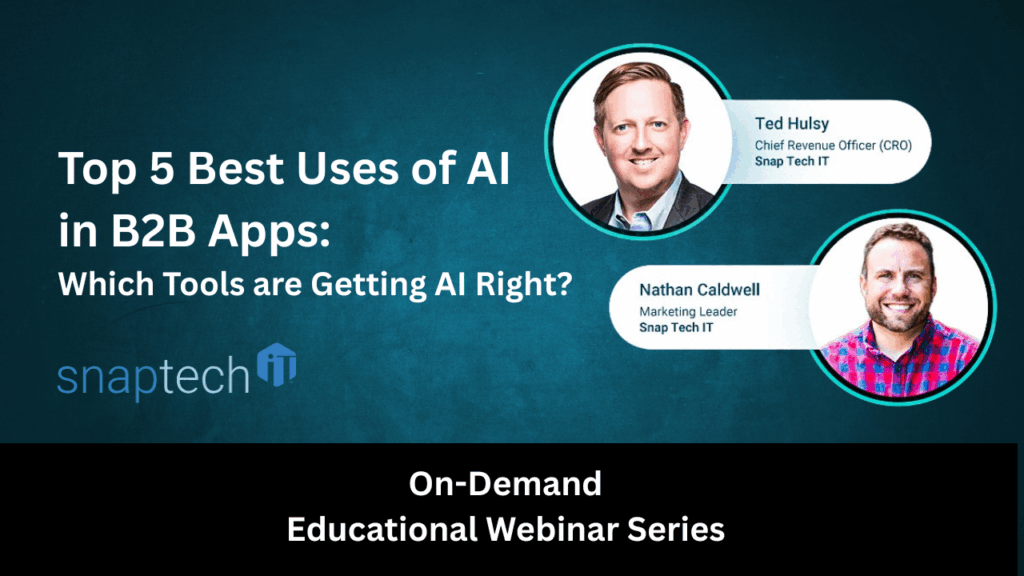
Top 5 Best Uses of AI in B2B Apps
Which Tools are Getting AI Right?
AI has been popping up in some interesting places all across software tools and applications that businesses rely on. It’s like the major software developers got the memo or understood the assignment. Instead of piling on new platforms, employees want to engage with AI where they are already working, and they want AI that accomplishes specific and effective tasks for the tools they’re working with. The goal? Reducing repetitive work, improving accuracy, and helping teams move faster. So, we’ve compiled 5 examples of popular business apps that are doing powerful things with AI right in their software. Without further delay, let’s dive in!
1. Canva: AI for Fast Digital Creation & No-Code Interactive Tools
Canva’s AI supports natural-language content creation, automated layout decisions, brand-matched formatting, and even the generation of interactive components like calculators, timelines, menus, and microsites. Users can describe business rules in plain language and Canva’s AI will build functional elements without any programming required.
Why this is powerful:
This type of no-code AI empowers small teams—especially those without internal developers—to produce digital experiences that would traditionally require custom development. It dramatically reduces production timelines and lowers cost barriers, making professional-grade web content attainable for non-technical staff. For SMBs, that means faster campaigns, quicker iteration, and more autonomy for marketing and operations teams.
2. Notta: AI-Driven Transcription and Knowledge Repurposing
Notta automatically transcribes video content, identifies speakers, exports subtitles for SEO-friendly YouTube uploads, and generates summaries or rewritten content using integrated AI. It turns meetings, webinars, and recordings into structured, searchable, reusable assets.
Why this is powerful:
Relying on video for communication is a step in the right direction, but without transcription, you’re missing out on a lot of the power you could have at your fingertips. Transcribing and storing those transcriptions in your AI database makes all of that knowledge inside the recordings accessible. AI transcription converts conversations into usable documentation—fuel for training, marketing, support, and even other AI systems like Copilot. The result is a more informed, more efficient organization where institutional knowledge doesn’t disappear into video archives.
3. Bill.com (Divvy): AI-Enhanced Accounts Payable Automation
Bill.com uses advanced OCR and machine learning to read invoices, extract key data, detect duplicates, categorize expenses, and route payments through automated workflows. As the system processes more invoices, it becomes increasingly accurate at coding and vendor recognition. Combine the Bill.com site along with the simplicity and connected power of the Divvy credit card, and you’ve got the perfect match to finally get everyone to get their expense reports in and correct!
Why this is powerful:
AI removes one of the biggest operational bottlenecks in finance—manual invoice handling. By reducing data entry, preventing errors, and accelerating approvals, businesses gain tighter cash-flow control and significantly reduce risk. This frees accounting teams to focus on financial strategy rather than paperwork, which is a major lift for small and mid-sized companies operating with lean staff.
4. ZoomInfo CoPilot: AI for Smarter Sales Operations
ZoomInfo CoPilot aggregates CRM data, call transcripts, public company information, and sales activity to generate call prep summaries, personalized outreach messages, account insights, and recommendations for next actions. It highlights triggers such as major events in your target prospect’s organization or leadership changes and uses AI to help sellers craft timely, tailored messages.
Why this is powerful:
Sales teams often spend more time preparing for conversations than actually having them. AI eliminates this research burden by reviewing data from multiple systems and converting that info into actionable insights. This allows sellers to respond faster, personalize consistently, and prioritize the highest-value opportunities. In competitive industries, this shift from manual research to AI-assisted strategy can dramatically increase pipeline velocity.
5. HubSpot AI: AI-Generated Sequences & Agent-Like Outreach
HubSpot integrates AI directly into CRM workflows, generating personalized outreach emails, customizing follow-ups based on account history, scoring leads, and even using an “agent-style” engine that builds individualized prospect messages using your website content and historical CRM interactions.
Why this is powerful:
AI transforms CRM from a logging tool into an active sales partner. Instead of writing repetitive messages or building campaigns from scratch, sales teams get instant, on-brand content tailored to each contact’s journey. This boosts output without sacrificing personalization—something difficult to achieve at scale manually. For SMBs, it means more high-quality outreach with less effort and fewer missed opportunities.
Why These Capabilities Matter
AI isn’t hype when it solves real business problems—slow processes, fragmented data, repetitive tasks, and limited staff capacity. The platforms above show how embedded AI helps organizations operate more efficiently and make better decisions while maintaining strong security and governance frameworks. For growing businesses, these capabilities give you the ability to remain competitive and accomplish more with less.
Do you have more AI questions?
If your organization wants guidance on evaluating AI tools, securing your environment, and identifying the right use cases, Snap Tech IT can help.
We firmly believe that technology should solve problems, not cause them.
Schedule a meeting today.
Watch the full webinar, including demos of these top 5 uses of AI here:

Nathan Caldwell
Marketing, Snap Tech IT