
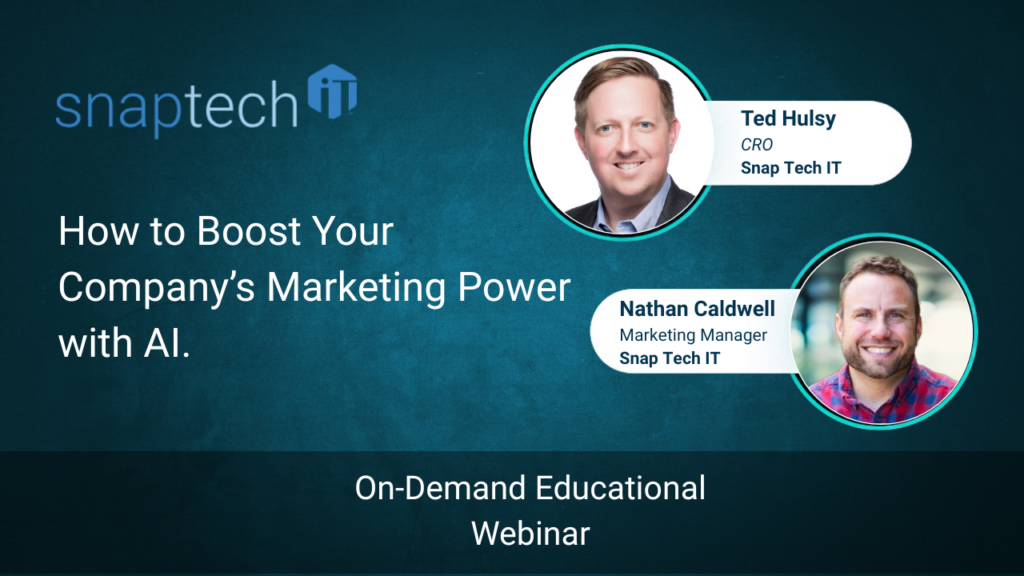
How to Boost Your Company’s Marketing Power with AI
It’s a competitive and segmented world where your audience and prospects aren’t all looking for you or finding you in the same ways. Which means, business leaders need to amplify their marketing efforts in a scalable way. There’s a need for stronger lead generation, better customer engagement, faster content creation, and measurable sales impact—all without dramatically increasing headcount. That’s exactly why AI is becoming one of the most valuable tools for modern marketing teams.
Why Businesses Are Turning to AI for Marketing
AI adoption is accelerating because the productivity gains are real. Research shows that marketers using AI are significantly more productive and can save hours every week on repetitive tasks. For organizations where marketing responsibilities are shared across executives, operations leaders, or small teams, those time savings matter.
But AI is not just about speed. It also creates opportunities for competitive advantage. Many companies are still only experimenting with AI tools, which means businesses that strategically implement AI now can gain momentum ahead of competitors who are slower to adapt.
The key is using AI intentionally across your marketing workflow.
Here are 6 ways to strategically embrace AI to boost your marketing power.
1. Cleaning and Organizing Data Faster
One of the most overlooked marketing challenges is data management. Sales and marketing teams constantly receive contact lists, event registrations, CRM exports, and prospect information in inconsistent formats. Organizing that data used to require complicated spreadsheet formulas and hours of manual cleanup.
Now, AI tools like Copilot in Microsoft Excel can quickly normalize and organize raw data using simple natural language prompts.
For example, if you were needing to clean up a spreadsheet of contact info from a marketing event, Copilot in Excel can:
- · Separate first and last names automatically
- · Correct formatting inconsistencies
- · Organize contacts by city or territory
- · Prepare data for CRM imports
- · Summarize product sales trends instantly
Clean data improves everything from campaign targeting to reporting accuracy.
2. Using AI Inside CRM Platforms
AI is becoming deeply integrated into sales and marketing platforms like HubSpot and Salesforce.
Instead of manually writing outreach emails, sales teams can now generate personalized messaging directly inside their CRM systems. HubSpot AI can instantly create professional event invitations and sales outreach emails tailored to specific audiences.
This allows sales teams to:
- Build campaigns faster
- Personalize messaging at scale
- Respond to prospects more quickly
- Spend more time in conversations instead of writing copy
AI can also help salespeople prepare for meetings by summarizing prospect information, identifying decision-makers, and highlighting technology insights before calls.
3. Repurposing Content Across Multiple Channels
One of the most practical AI strategies for marketing is content repurposing.
Many businesses create valuable content through webinars, meetings, podcasts, or internal discussions—but that content often gets used only once. AI changes that.
AI transcription tools like Notta.ai or even Microsoft Teams features allow you to transcribe webinars and meetings. Those transcripts can then become:
- Blog articles
- Social media posts
- SEO website content
- YouTube transcriptions
- Sales enablement materials
- Downloadable guides
This approach dramatically increases the return on every piece of content a business creates.
Successful content repurposing keeps messaging consistent across platforms while allowing customers and prospects to consume information in the format they prefer and/or find (remember, everyone isn’t following the same path to discover you).
4. Building Smarter Content Workflows
Creating a high-quality blog involves more than writing an article. Businesses also need SEO titles, meta descriptions, focus keyphrases, excerpts, image concepts, and structured formatting for publishing platforms.
Instead of recreating those elements manually every time, you can build a custom GPT specifically designed for blog creation and SEO publishing workflows.
The result is faster production without sacrificing quality or consistency.
Importantly, AI-generated content should still be reviewed and edited by humans. AI is most effective when paired with subject matter expertise and brand knowledge.
5. Accelerating Design and Marketing Materials
AI is also changing how businesses create professional marketing assets.
AI tools like Claude are becoming exceptionally powerful at creating polished materials such as white papers, PDFs, or client-facing resources. By using existing transcripts and source materials you can set your preferred AI tool down the path of getting your publication to 80%-90% complete. So, rather than starting from scratch with a designer, you can count on AI for a very strong first draft that designers and marketers can refine. While this helps with branding, it’s also a giant time savings. Instead of outsourcing to a designer to start from scratch with a completion timeline of a full business week, you could have minimal edits and polishing needed by a designer and have it back in just a couple days, at a significantly reduced price. This is a powerful alternative to having to hire and manage a full in-house creative team.
6. AI Should Amplify Your Expertise
One of the biggest strategies to embrace is remembering that AI should enhance your organization’s expertise—not replace it.
Businesses still need strong ideas, industry knowledge, and a clear point of view. AI simply helps teams execute faster, organize information better, and scale content creation more efficiently.
Organizations that embrace AI strategically are already seeing gains in productivity, customer engagement, and sales enablement.
The question is no longer whether AI belongs in your marketing strategy. The question is how quickly your business can begin using it effectively. Where are you on your AI adoption journey? Take a 15 minute assessment to discover your AI-readiness score, a custom-crafted roadmap, and a list of next steps for you to take to get AI-ready.
Ready to take the next step in your AI journey?
AI is becoming more practical for everyday business work. But before you can embrace the power of AI, you need to know if your business is ready for it.
It takes proper evaluation to ensure that your environment, data, and people are ready to use it securely, practically, and with the right protections in place.
To determine how ready your business is, and the next steps you need to take, fill out our free AI Readiness Assessment. In 15 minutes, you’ll know where you stand and what you need to do to be AI-Ready.
Watch the full webinar here:

Nathan Caldwell
Marketing, Snap Tech IT