
Construction Firms Don’t Need More AI Tools—They Need a Better AI Foundation
The construction industry is currently facing the highest spike in challenges in years, with rising material costs, supply chain issues, and labor shortages. These challenges are strongly motivating construction companies to shout, “We want AI and we want it now!” But AI won’t solve efficiency problems until construction firms address the underlying issues of poor documentation, broken communication, and operational inconsistency. AI can absolutely help with all of these underlying issues—but only when it’s built on the right foundation.
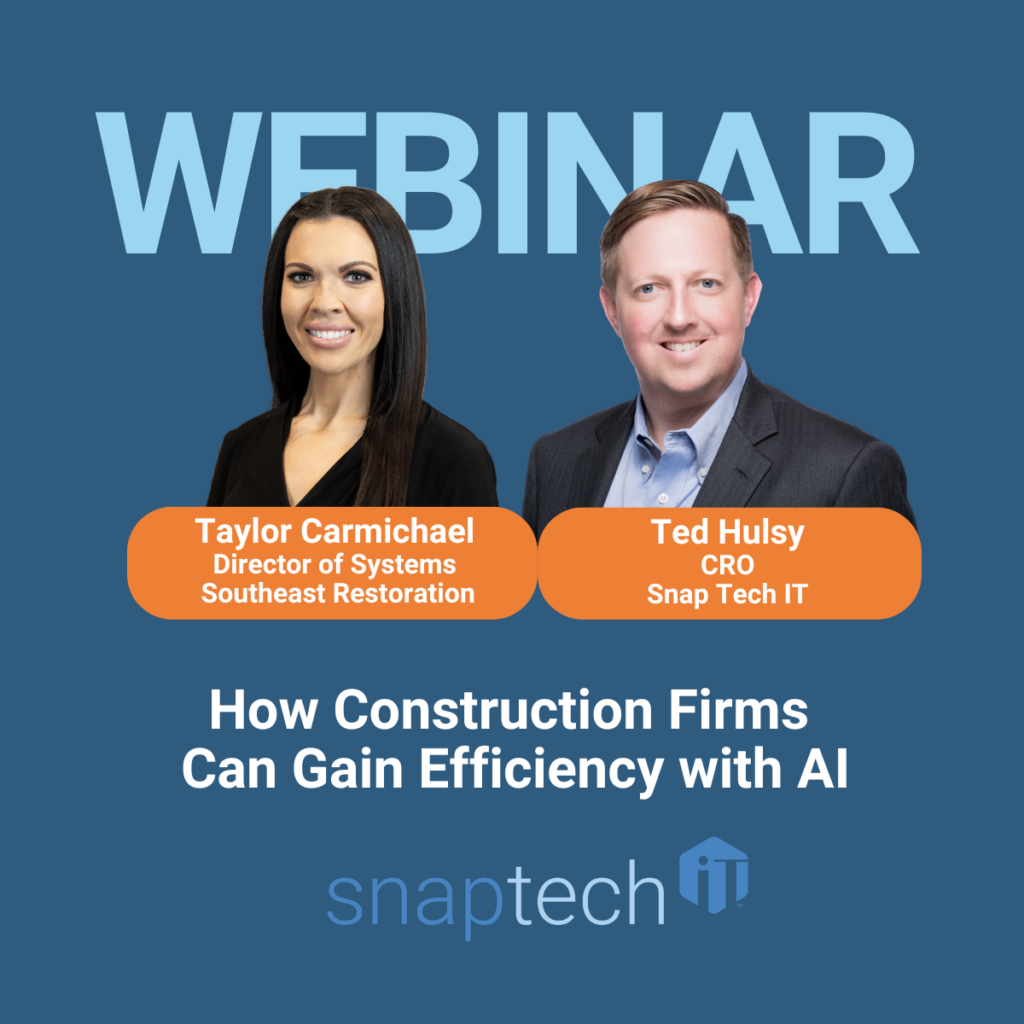
In a recent Snap Tech IT webinar, our special guest speaker, Taylor Carmichael from Southeast Restoration revealed the AI journey her construction firm has been on and what other construction firms need to do to win with AI.
How Can Construction Firms Adopt AI?
Many contractors jump straight into the latest AI platform expecting instant productivity. In reality, AI simply amplifies the systems already in place. If your workflows are inconsistent today, they’ll become inconsistently faster tomorrow.
The quality of your AI output will never exceed the quality of your input systems or lack of AI strategy.
It’s a simple formula: Quality of Input x AI Strategy = Quality of AI Output
Here’s a simple path for Construction firms who wants to adopt AI.
1. Identify your friction points.
Where is time being wasted? Where is information being lost? You cannot automate a problem that you haven’t yet mapped out yourself.
2. Document clearly and consistently.
If your technicians are writing job notes five different ways, AI is going to produce five different outputs. Garbage in, garbage out.
3. Organize your knowledge base.
SOPs, templates, scope language, carrier specific requirements should all be properly documented, organized, and used appropriately to produce better AI results. Any information locked in someone’s head or buried in a folder somewhere is AI’s absolute worst enemy.
4. Explorie AI tools.
Once you’ve made your way carefully through the first three steps, AI will have something real to work with. But don’t just set it loose. Be sure to give strategic consideration to governance and security.
Once you are confident you have the right AI tools to do the job, you’ll be leveraging a firm foundation and your AI strategy will reward you over time.
How Did Southeast Restoration Adopt AI in their Construction Firm?
“We started with sales and documentation because it was our highest friction area. We had to slow down long enough and determine what problem are we actually trying to solve before we decided on an AI tool to use. We built AI agents that represent our organization and our brand consistently, not just one-off prompts. We coached voice dictation in the field so team members can speak their notes on site instead of manually typing them in on a tablet. And we also automated loss descriptions so adjusters can get consistent narratives of the loss every time.
In the beginning, we made mistakes by chasing shiny tools before our foundation was truly ready to layer AI on top of it. We didn’t answer governance and security questions up front and we paid for it mid-roll out. The biggest lesson learned was change management was harder than the technology itself. It doesn’t matter how good the tool is if your team won’t change their behavior.”
– Taylor Carmichael, Director of Systems at Southeast Restoration
The strategy for a firm foundation is clear: clean data, clear workflows, and defined roles.
How Is AI Being Used in Construction Today?
Construction firms are finding success by applying AI to repetitive administrative work instead of trying to automate professional judgment. Industry leaders are using AI to summarize field notes, generate inspection reports, draft customer communications, organize documentation, and compare estimate revisions—all tasks that traditionally consume hours of manual effort.
The biggest opportunity isn’t replacing expertise. It’s giving experienced employees more time to use it.
What Tasks Can AI Automate for Contractors?
The highest-value use cases are often the simplest.
A field technician can dictate jobsite observations into a secure AI assistant and receive a structured inspection report in minutes. Project managers can quickly draft empathetic customer updates after schedule changes. Estimators can compare estimate revisions or generate first-draft scopes that are reviewed before submission.
The common thread is that AI produces the first draft—not the final decision.
Human review remains essential because construction projects involve safety, compliance, insurance requirements, and customer expectations that no AI model fully understands.
Will AI Replace Construction Workers?
No—but it will change how they work.
Construction continues to face skilled labor shortages, making productivity more important than ever. Rather than replacing project managers, estimators, or field technicians, AI helps them spend less time writing reports and more time solving customer problems.
One of the most valuable applications is preserving institutional knowledge. Standard operating procedures, estimating practices, and documentation standards that once lived only in experienced employees’ heads can be captured and shared across the organization.
How Can Construction Companies Use AI Securely?
Before deploying any AI tool, leadership should answer three questions:
- Is company data used to train shared AI models?
- Who can access customer and project information?
- What happens to your data if you stop using the platform?
Equally important is governance. Employees need clear guidance on which AI tools are approved, what information can never be entered into public AI systems, and how AI-generated work should be reviewed before it reaches customers or insurance carriers.
Technology should improve consistency—not introduce new risk.
Start Small and Scale with Confidence
The most successful AI initiatives don’t begin with buying software. They begin by identifying one operational friction point.
Maybe it’s inspection reports. Maybe it’s customer communication. Maybe it’s estimate consistency.
Solve that one problem first. Measure the results. Build internal confidence. Then expand from there.
At Snap Tech IT, we help organizations move beyond AI experimentation by creating secure, scalable adoption strategies that align technology with real business outcomes. If you’re ready to build an AI roadmap that improves efficiency without compromising security or governance, schedule a conversation with our team. We’d love to help you turn AI into a competitive advantage.
Preparing for AI in Your Business
Construction firms that take the time to build a firm foundation, embrace AI, and train their teams to be proficient with it will uncover new ways to face the unique challenges the construction industry is facing as a whole.
That firm foundation begins with establishing governance, security controls, data access, and high-quality team member training.
If your team is exploring how to safely implement AI in your organization, we have a powerful tool for you. It’s our AI Readiness Assessment. It’s a free tool that will give you an AI readiness scorecard, a strategic roadmap, and recommended next steps – delivered to your inbox.
Watch the full webinar here:

Nathan Caldwell
Marketing, Snap Tech IT