
Top AI Predictions for 2026
What You Should Do To Get Your Business Ready
AI isn’t coming “someday.” For many businesses, it’s already quietly reshaping how work gets done—inside accounting systems, CRMs, email platforms, and customer service tools. The real question for 2026 isn’t if AI will matter, but whether your business will be ready to use it well.
Based on real-world conversations with business leaders and hands-on experience, here are the most important AI predictions for 2026—and what smart organizations should be doing now.
1. AI Literacy will become a Mandatory Skillset
In 2026, AI won’t be a side experiment for curious employees. It will be embedded in most business software, from finance and marketing tools to HR and operations platforms. Teams won’t be measured just on effort or experience—but on how effectively they use AI-enhanced tools.
The businesses that pull ahead will invest in training their existing employees, not just buying new technology. AI skills will become a baseline expectation. Companies that skip enablement will risk creating productivity gaps inside their own teams.
What to do now: Budget for AI training and set expectations that AI is part of how work gets done.
2. AI Takes Over Admin Work People Hate
Administrative work is one of the biggest productivity drains in most organizations. In 2026, AI will routinely handle first drafts of proposals, contracts, reports, emails, and meeting notes.
Instead of starting with a blank page, employees will start with an AI-generated draft—and then apply judgment, expertise, and context. Meetings will be recorded, transcribed, summarized, and converted into action items automatically, reducing confusion and follow-up delays.
What to do now: Standardize “AI for first drafts” across the business and require a human review step for anything customer-facing, financial, legal, or compliance-related. Give employees permission to use AI for repetitive and administrative tasks—and define guardrails for review and accountability.
3. AI will Eliminate Hold Times
Customers increasingly expect immediate service, and AI will raise the bar again in 2026. Customers would rather interact with a voice bot that can handle simple questions or tasks than wait on hold or never get through to someone.
AI can also support human reps during calls by surfacing context and suggestions in real-time. This will be a powerful way to boost expertise, knowledge, and familiarity with your customers’ specific circumstances for your service reps and sales reps.
What to do now: Identify the top 20 repetitive customer questions and pilot a chat/voice agent for those—while also testing “AI assist” tools that help your live team respond faster.
4. AI will Continue to be Driven by Power User and Executive Experimentation
AI adoption happens when organizations empower experimentation—especially among power users and leaders who like to explore new tools. The best organizations make failure acceptable and create a nucleus of AI champions who meet regularly to share what’s working. That internal momentum is what turns isolated experimentation into repeatable adoption.
What to do now: Form an internal “AI pilot group” (4–6 curious employees), give them a sandbox, and ask them to bring one proven use case per month back to the wider team.
5. Microsoft Copilot Adoption will Triple in 2026
Until now, Microsoft Copilot adoption has been held back by two things: early performance gaps and pricing that made broad rollout expensive. Current signals from Microsoft suggest those barriers are easing—especially as Copilot improves and becomes more cost-accessible—making it realistic for companies to move from a handful of licensed users to wider deployment. The big advantage is reduced friction: it’s embedded directly in tools people already work in, like Outlook and Teams.
What to do now: Run a 30-day Copilot pilot with defined success metrics (meeting summaries, email drafting time saved, action item capture), then decide whether to expand org-wide.
6. Google Will Gain Significant Share in the Cloud Productivity War Vs. Microsoft 365
Google’s bundling strategy, Gemini included with Google Workspace, is a strong incentive, especially for SMBs and newer companies. While it is true that switching platforms is a heavy lift for established businesses and retraining costs may outweigh the savings, the competitive pressure is real, and AI is now a key component in the productivity suite battle.
What to do now: If you’re already on Microsoft 365, compare “Copilot rollout vs. switching cost” before making a move. If you’re a newer business, evaluate Google Workspace + Gemini as a default option.
7. AI Everywhere Reaches an Inflection Point
AI isn’t just “ChatGPT.” AI is exploding inside departmental tools—CRMs, marketing platforms, finance apps, and even industry-specific tools like retail shopping apps. The practical takeaway: for many business problems, there’s already an AI product you can subscribe to and test, without building from scratch.
What to do now: Make a shortlist of 3 core systems (CRM, accounting, ticketing, etc.) and identify which AI features you’re already paying for—but not using—and activate them first.
8. AI Will Show Up in Meaningful Productivity Gains in the U.S., Not In Job Losses
AI is driving productivity gains more than immediate job destruction. Even when people become faster, they don’t stop working—they take on more challenges, increase output, and improve service. We will also see many leaders use AI to reduce hiring or reshape roles over time. The core message: expect evolution, not overnight collapse.
What to do now: Plan for role changes: update SOPs, redefine expectations, and measure productivity gains (time saved, faster response, fewer errors) so improvements are intentional—not accidental.
Getting Ready for 2026
AI is becoming embedded, expected, and unavoidable. The businesses that win won’t be the ones with the fanciest tools—but the ones that prepare their people to use AI responsibly, securely, and effectively.
If you’re not sure where to start, Snap Tech IT helps organizations build practical AI strategies that improve productivity without creating new risks.
Do you have more AI questions?
Ready to talk about what AI should look like in your business? Let’s schedule a meeting and get you prepared for 2026.
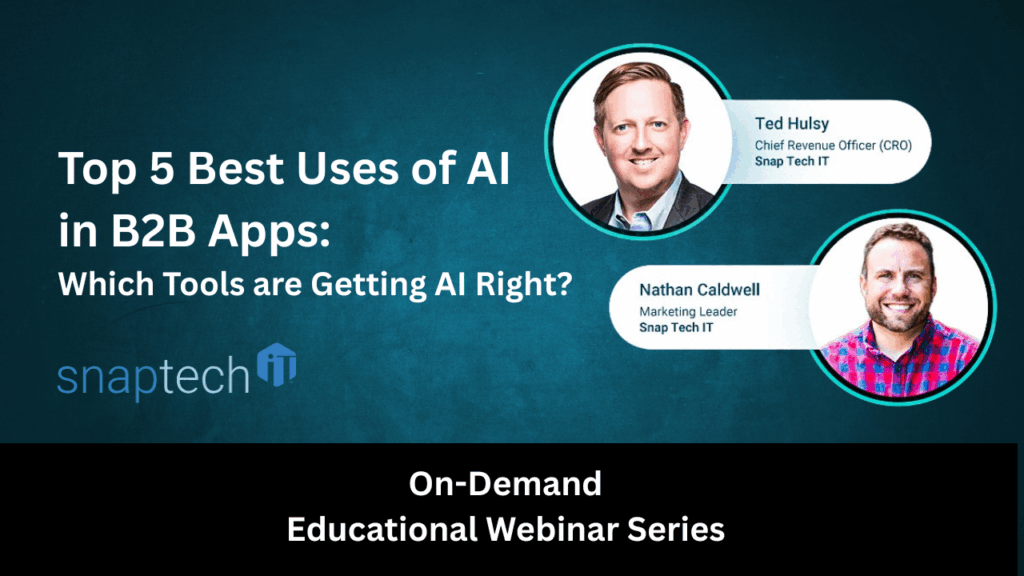
Watch the full webinar here:

Nathan Caldwell
Marketing, Snap Tech IT