
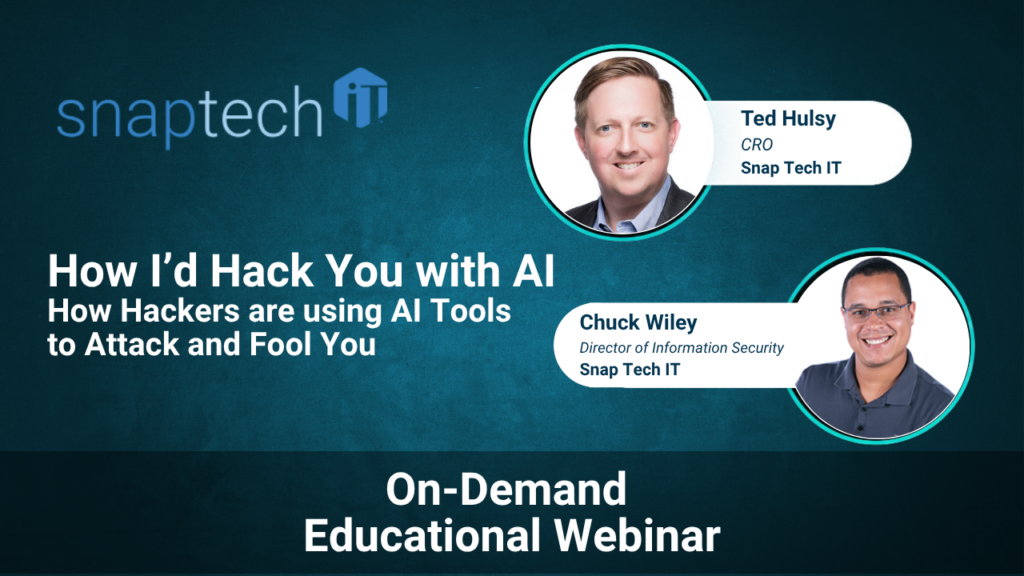
How I’d Hack You with AI:
How Hackers are Using AI Tools to Attack and Fool You.
What if a hacker could impersonate your CFO, recreate your company website, and convince an employee to transfer money—all without breaking through your firewall?
Artificial intelligence (AI) is making that scenario increasingly realistic. Cybercriminals can now use AI to launch convincing attacks faster, with less effort and fewer technical skills.
For business leaders, the challenge isn’t simply keeping hackers out of your network. It’s protecting employees, business processes, and AI-powered tools from manipulation.
Here’s how these attacks work and what your organization can do to reduce its risk.
How Are Hackers Using AI to Target Businesses?
Cybercriminals have always researched their targets. What’s changing is how quickly AI can turn publicly available information into convincing attacks.
An attacker might gather information from your company website, social media profiles, or documents accidentally exposed online. These details can help them identify employees, understand business relationships, and develop targeted phishing campaigns.
AI accelerates this process by generating realistic messages, analyzing information, and helping attackers identify weaknesses.
The result? A cyberattack that once required extensive preparation can potentially be assembled in an afternoon.
Why Are AI-Powered Phishing Attacks Harder to Detect?
Traditional phishing awareness often focuses on poor grammar, suspicious logos, and unusual email addresses.
Those warning signs aren’t enough anymore.
AI can produce professional emails that imitate someone’s writing style, reference actual business projects, or continue an existing conversation.
Attackers may also exploit legitimate file-sharing services. An employee might receive a real Dropbox notification containing a link to a malicious destination.
That’s why employees need to question unexpected requests, even when the message looks legitimate.
Urgency, unusual payment instructions, and requests for credentials should trigger verification—not immediate action.
Can Hackers Use AI to Impersonate Your Employees?
Yes. AI-powered voice cloning and deepfake videos introduce another layer of deception.
With a short audio recording, attackers can generate a convincing imitation of someone’s voice. They can also manipulate videos, photographs, invoices, and websites to make fraudulent communications appear authentic.
Imagine an accounting employee receiving a voicemail that sounds exactly like the CFO requesting an urgent wire transfer.
Without an established verification process, that employee might unknowingly send money to an attacker.
The solution isn’t expecting employees to recognize every deepfake. It’s establishing procedures that work even when an impersonation looks or sounds convincing.
What Is Shadow AI, and Why Is It a Security Risk?
Shadow AI occurs when employees use AI applications that haven’t been reviewed or approved by their organization.
Consider an employee uploading a customer list, confidential contract, or patient information into a free AI tool to summarize it.
Or an AI meeting assistant recording sensitive conversations through a personal account.
These employees may simply be trying to improve productivity. Unfortunately, the organization loses visibility into where its information goes and how it’s handled.
For companies managing financial, healthcare, or other sensitive information, that creates significant security and compliance concerns.
Businesses need clear policies identifying approved AI tools and appropriate uses of company data.
Can AI Assistants Become an Entry Point for Cyberattacks?
AI assistants introduce another emerging threat: prompt injection.
Some assistants can access emails, shared files, calendars, and business applications. They may also perform actions on behalf of employees.
An attacker could hide malicious instructions inside a document the assistant processes.
For example, an invoice might contain concealed instructions directing an AI assistant to change payment information.
If the assistant follows those instructions, it could redirect funds without a traditional account compromise.
Organizations should limit AI permissions, carefully review third-party integrations, monitor activity, and require human approval for sensitive actions.
How Can Businesses Protect Themselves From AI-Powered Cyberattacks?
An effective cybersecurity strategy combines technology, employee education, and reliable business processes.
Start with these five priorities:
- Strengthen authentication. Enable multifactor authentication (MFA), prioritizing phishing-resistant methods for executives, finance teams, and IT administrators.
- Apply zero-trust principles. Restrict access to necessary systems, applications, and sensitive data.
- Train employees continuously. Use short, frequent security lessons and realistic phishing simulations instead of relying on annual training.
- Monitor threats around the clock. Managed Detection and Response (MDR) and Identity Threat Detection and Response (ITDR) help identify and contain suspicious activity.
- Establish AI governance. Inventory AI tools, approve integrations, and require independent verification for financial transactions and sensitive data changes.
Most importantly, create a culture where employees feel comfortable reporting suspicious activity, even when they’re uncertain.
Make AI Security a Business Priority
AI creates tremendous opportunities for productivity and innovation. But as cybercriminals adopt the same technology, businesses must modernize their defenses.
Strong authentication, continuous training, controlled AI access, and documented verification procedures can help protect your organization without slowing progress.
Not sure whether your business is prepared for AI-powered cyberattacks? Schedule a call with Snap Tech IT. Our cybersecurity experts can help you evaluate your risks, strengthen your defenses, and build a practical strategy that protects your business as AI continues to evolve.
Watch the full webinar here:

Nathan Caldwell
Marketing, Snap Tech IT